
Skrivet av Redaktionen • 29 juli, 2026 06:10
Intervjun:
Michael-Robin Witt — Founder, CEO & CSO

Michael-Robin Witt — Founder, CEO & CSO
This interview is part of a paid partnership.
Michael-Robin Witt on GT-002, Phase II and Gabather’s Future
Following positive Phase I results demonstrating that GT-002 is safe, well tolerated and reaches the brain without benzodiazepine-like sedation, Gabather is now preparing for its fully funded Phase II study, financed by Innovation Fund Denmark, an independent fund established and financed by the Danish government. The company is advancing GT-002, a selective GABA-A receptor modulator, into its first study in patients—targeting one of psychiatry’s largest areas of unmet need, the cognitive symptoms of schizophrenia, for which no approved medicine currently exists.
Having already demonstrated target engagement in healthy volunteers, Gabather has taken the decisive step from laboratory science to the clinic. In this interview, CEO Michael-Robin Witt discusses the Phase II programme, the broader pipeline, and the investment case for Gabather.
| 1. What does Gabather do? |
Gabather is a Swedish clinical-stage pharmaceutical company developing new treatments for psychiatric and neuropsychiatric disorders. Our work is built on translating rigorous neuroscience into medicines that reach patients — taking a scientific idea from the laboratory bench to the clinical bedside.
Our research focuses on the GABA system, the brain’s principal inhibitory signalling system, which plays a central role in maintaining the balance and coordination of neuronal activity. Our most advanced drug candidate, GT-002, is a selective, α3-preferring positive allosteric modulator of the GABA-A receptor.
GT-002 is currently being evaluated as a potential treatment for cognitive impairment associated with schizophrenia. Cognitive difficulties can have a profound effect on a person’s ability to work, study, maintain relationships and live independently, yet this area remains poorly addressed by existing medicines.
Beyond GT-002, we are building a broader pipeline of compounds emerging from the same GABA-focused research platform, and we continue to investigate the wider potential of GABA-A modulation in other areas where brain activity and cognition may be therapeutically relevant.
| 2. Tell us about your Phase I study. What aspects of the study are you particularly pleased with, and how do you relate those results to Phase II? |
GT-002 has completed three clinical studies in healthy volunteers — single-ascending-dose, multiple-ascending-dose and EEG/fMRI target-engagement studies — and the finding that pleased us most speaks directly to whether the compound does what it is designed to do.
The EEG and functional MRI results demonstrated that GT-002 reaches and affects the human brain. We observed measurable modulation of brain activity and neuronal networks without the sedative profile normally associated with classical benzodiazepines. This is important because it provides evidence of target engagement: the compound is not simply present in the blood, but is producing measurable effects in the organ we are targeting — and doing so with a clean, non-sedative neural signature.
Alongside this, GT-002 was safe and well tolerated at the doses studied, with a pharmacokinetic profile compatible with convenient oral administration.
The Phase I results do not establish clinical efficacy in patients. That is precisely what the Phase II programme is designed to investigate. But the combination of a favourable safety profile, workable pharmacokinetics and clear, non-sedative effects on brain activity gave us a strong scientific basis for advancing GT-002 into patients — the next stage in taking this science from bench to bedside.
| 3. What are the prerequisites for Phase II? And have you initiated this study? |
Before initiating Phase II, we needed a complete clinical protocol, the required regulatory and ethical approvals, suitable clinical trial material and an experienced clinical research centre capable of conducting a technically demanding study.
These prerequisites have now been fulfilled, and the Phase II study has been initiated.
The study is called TOTEMS and is being conducted at the Centre for Neuropsychiatric Schizophrenia Research at Copenhagen University Hospital. It is a double-blind, randomised study comparing GT-002 with placebo and an active comparator.
The study is designed to include 20 patients with schizophrenia and 30 healthy volunteers, and is deliberately biomarker-rich: it examines cognitive and psychophysiological effects using a comprehensive set of measurements, including EEG, electromyography and cognitive testing. This exploratory design is intended to tell us not only whether GT-002 has an effect, but how it acts on brain function — information that is highly valuable in shaping the larger studies that would follow.
Recruitment and clinical examinations have commenced. As with any clinical study, recruitment will proceed sequentially and carefully in accordance with the protocol. This is an important milestone for Gabather, because it is the first clinical study of GT-002 in patients — the point at which our laboratory science meets the people we ultimately aim to help.
| 4. How is the Phase II study financed? |
The TOTEMS Phase II study has been made possible through an investment agreement with Innovation Fund Denmark.
The total study budget is approximately DKK 12 million, corresponding to approximately SEK 18.6 million when the collaboration was announced. This financing supports the clinical study conducted by the Centre for Neuropsychiatric Schizophrenia Research and significantly reduces the direct financial burden of carrying out the study for Gabather.
For a company of our size, this is extremely valuable. It allows us to generate high-quality clinical data in collaboration with internationally recognised schizophrenia researchers while using our own financial resources efficiently — capital we can instead direct towards advancing the wider pipeline.
It is also an important external validation of the scientific quality of both GT-002 and the Phase II study concept. Innovation Fund Denmark subjected the project to an independent scientific and commercial assessment before agreeing to support it.
| 5. Tell us a little about yourself! |
I am a neuropharmacologist by training, with a PhD and a career centred on the pharmacology of the GABA-A receptor — the system GT-002 acts on. After more than a decade in academia I held senior scientific roles in Scandinavian biotech and pharma, including NeuroSearch and AstraZeneca R&D, co-founded Axcentua Pharmaceuticals, and today am the founder, CEO and Chief Scientific Officer of Gabather.
GT-002 is, in a real sense, an outgrowth of that scientific work: its chemical class traces back to a flavonoid-derived GABA-A modulator concept I helped to originate. Following that pharmacology from an academic idea through to a synthetic, drug-like molecule now entering patients is exactly the bench-to-bedside journey that motivates me.
What continues to drive me is the combination of a strong scientific foundation and a very clear unmet medical need. Developing medicines for psychiatric disorders is exceptionally challenging, but it is also an area in which genuinely innovative treatments could have an enormous impact on patients, families and society.
As CEO of a small biotechnology company, my role is to bring together the scientific, clinical, financial and commercial elements required to move the programme forward, which means being closely involved across the organisation. My own centre of gravity is the science. On the business-development and partnering side we are deliberately well supported: we work with experienced external advisers and partners, and we have a board that combines deep pharmaceutical-development, financial, legal and public-company governance expertise to guide our strategic and partnering discussions. That structure lets me stay close to the science while ensuring partnering is led by people who do it at the highest level.
| 6. What treatments are currently available on the market in this field, and why is your approach and potential drug candidate superior? |
Schizophrenia is currently treated primarily with antipsychotic medicines, supported by psychological, social and rehabilitative interventions.
Most established antipsychotics act mainly by modulating dopamine signalling. These medicines can be effective against positive symptoms such as hallucinations and delusions, but they often have limited effect on cognitive impairment and negative symptoms. They may also cause significant adverse effects, including movement disorders, sedation, weight gain and metabolic complications.
Considerable effort has gone into treating the cognitive symptoms specifically, through a range of mechanisms, and this has proven to be one of the hardest problems in the field. Most recently, a large Phase III programme evaluating a glutamatergic (glycine-transporter) mechanism did not demonstrate a significant cognitive benefit. As a result, there is still no pharmacological treatment approved anywhere for cognitive impairment associated with schizophrenia. That history underlines both how difficult the target is and how large the opportunity remains for an approach that succeeds.
GT-002 represents a fundamentally different approach. Rather than acting primarily on dopamine receptors — or on the glutamatergic mechanisms that have so far disappointed — it is a selective, α3-preferring modulator of the GABA-A receptor system. Our aim is to influence the function and coordination of neuronal networks involved in cognition without causing the broad sedation associated with classical benzodiazepines.
At this stage, we should not claim that GT-002 is clinically superior to existing medicines, because this has not yet been demonstrated in patients. What we can say is that it has a differentiated mechanism of action, has produced a non-sedative neural signature in healthy volunteers, and is being developed for an area of substantial unmet need where other mechanisms have not yet delivered.
The Phase II study is intended to determine whether these promising pharmacological and neurophysiological characteristics can translate into meaningful effects in people with schizophrenia.
| 7. How many shares are currently outstanding in Gabather? |
As of 13 July 2026, Gabather has 610,491,290 outstanding shares.
The Gabather share is traded on Nasdaq First North Growth Market Stockholm under the ticker GABA, with ISIN code SE0010869552.
As always, investors should refer to Gabather’s latest published financial reports and regulatory announcements for the most current information regarding shares, warrants and other instruments that could affect the company’s capital structure.
| 8. Do you have any ongoing or announced capital raising? |
Gabather does not currently have an ongoing capital raising that has been publicly announced.
In February 2026, we announced a directed share issue of approximately SEK 4.2 million. That financing has been completed and strengthened the company’s financial position as we entered the operational phase of the Phase II programme.
As a clinical-stage biotechnology company without product revenue, Gabather must continuously evaluate its future financing requirements. The exact timing and form of any future financing will depend on factors such as clinical progress, business-development opportunities, market conditions and the company’s strategic priorities.
We can, of course, only comment on financing transactions or discussions that have been publicly disclosed in accordance with applicable market-abuse and disclosure regulations.
| 9. How large is the market for neuropsychiatric disorders? |
The overall market for psychiatric and neuropsychiatric disorders is extremely large, but it is more meaningful to look at the specific patient populations relevant to our development programmes.
Schizophrenia affects approximately 24 million people worldwide. It is a severe and often lifelong disorder that can affect cognition, employment, social relationships and the ability to live independently, and it creates a substantial economic burden through healthcare costs, lost productivity and the need for long-term social support. Cognitive impairment in particular affects an estimated three-quarters of people with the condition — on the order of 18 million individuals — and is among the strongest predictors of long-term disability.
Existing medicines address some aspects of schizophrenia, particularly positive psychotic symptoms, but cognitive impairment remains a major unmet medical need. The opportunity should therefore not be understood only in terms of the number of patients; it is also defined by the absence of satisfactory treatments for the symptoms that have the greatest effect on patients’ everyday functioning.
Our immediate clinical focus is therefore not the entire neuropsychiatric market. It is the more clearly defined opportunity to develop a differentiated treatment for cognitive impairment associated with schizophrenia.
If GT-002 demonstrates clinical activity, its mechanism could also be relevant in additional psychiatric and neurological indications — and the same GABA-focused platform that produced GT-002 continues to generate further pipeline candidates.
A clear example of that broader potential is a newer initiative we have been developing around restorative sleep and what we term neural healthspan — the length of time the brain retains its functional integrity as we age. Ageing involves a self-reinforcing cycle in which fragmented sleep drives stress and low-grade inflammation, which in turn further degrade sleep. The GABA-A system sits at the centre of sleep regulation, and our human EEG data suggest that GT-002 can modulate sleep-relevant brain activity while preserving sleep continuity — restoring sleep physiology rather than inducing the sedation associated with classical benzodiazepines. On that basis we have designed a proof-of-concept sleep-EEG study in older adults, focused on slow-wave sleep and next-day cognition. This points beyond any single disorder towards supporting healthy brain function across the lifespan, and towards a much larger population — and, as with our other opportunities, it would require its own dedicated development and validation.
| 10. Give three reasons why investors should consider investing in Gabather at this time! |
First, Gabather has a clinically tested drug candidate with a differentiated mechanism of action. GT-002 has completed three clinical studies in healthy volunteers, has been shown to be safe and well tolerated at the doses studied, and has demonstrated measurable effects on human brain activity without a conventional benzodiazepine-like sedative profile.
Second, we have now entered an important value-creating phase. The TOTEMS Phase II study has been initiated and is evaluating GT-002 in patients with schizophrenia for the first time. By combining cognitive testing with advanced neurophysiological biomarkers, it is designed to show not only whether GT-002 produces an effect, but how it influences brain function.
Third, the study is supported by Innovation Fund Denmark and conducted with a highly experienced academic clinical partner. This provides substantial external scientific validation and lets Gabather run a sophisticated clinical study with a comparatively efficient use of the company’s own capital.
Beyond these three points, Gabather is more than a single asset. GT-002 is the most advanced expression of a research platform that continues to generate further pipeline compounds, and its mechanism may have potential well beyond schizophrenia — including a new initiative applying GT-002 in restorative sleep and neural healthspan, an area with a much larger population and a strong mechanistic rationale in the GABA-A system. A company that can repeatedly take neuroscience from the laboratory bench to the clinical bedside is building something durable — and positive Phase II findings could open the door to pharmaceutical partnerships or licensing discussions.
Underpinning all of this is a layered patent estate — from composition-of-matter through to later formulation and precision-medicine filings — that extends potential exclusivity into the 2040s.
Taken together, the reasons to look at Gabather now are a differentiated candidate, an active and well-designed patient study, strong external validation, and a pipeline behind the lead programme — with the first patient data on GT-002 still ahead of us.
Gabather remains, of course, a clinical-stage biotechnology company, and clinical development is inherently uncertain. Investors should weigh the risks associated with study outcomes, regulatory approval, future financing and commercialisation, and assess Gabather on the combination of its scientific potential and those risks.
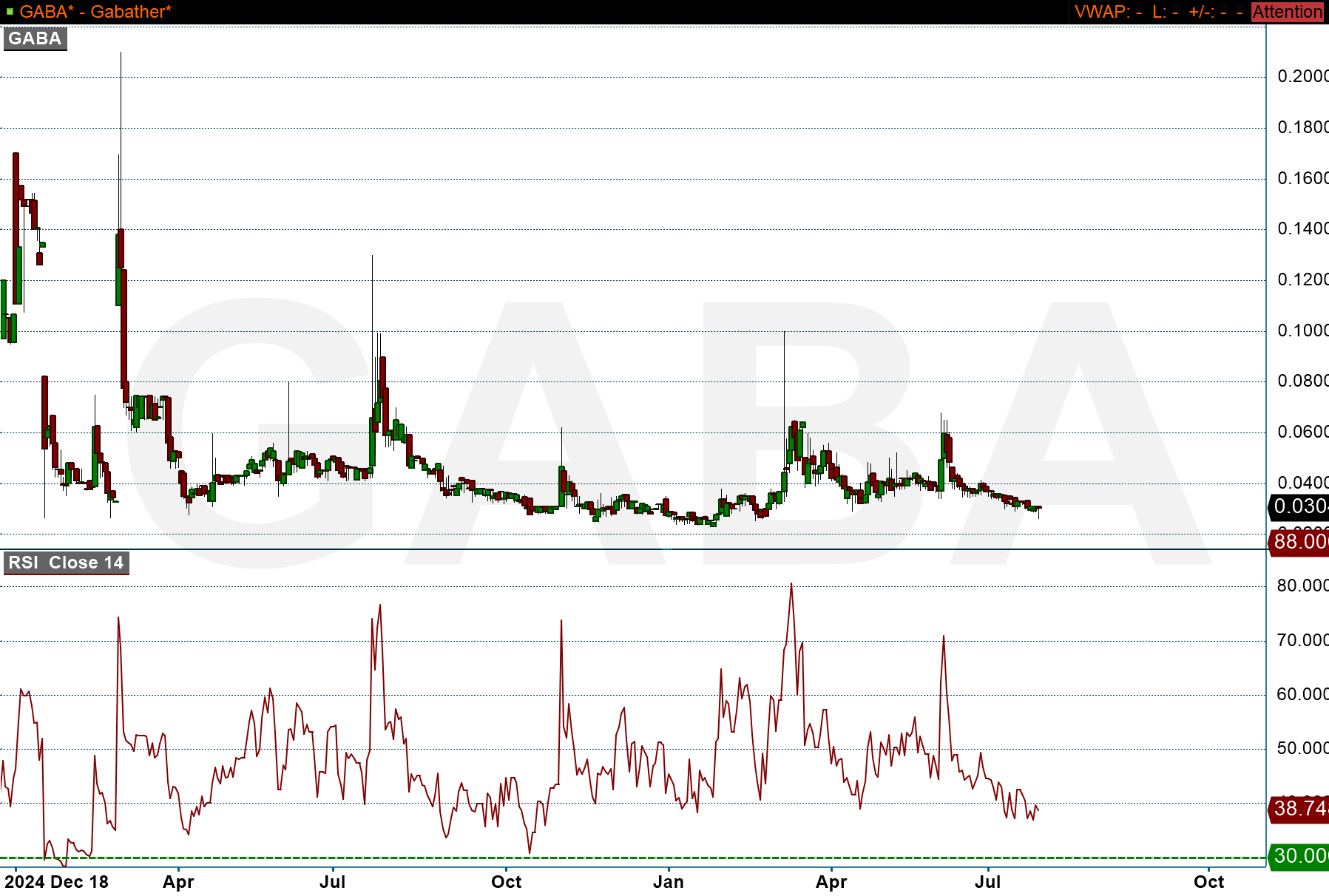
Diagram ovan: Gabather, dagsdiagram (källa: Infront/Dagens Börs)


