
Skrivet av Redaktionen • 23 november, 2026 06:31
Intervjun:
Ebrahim Laher (CEO) White Pearl Tech Group

Ebrahim Laher (CEO) White Pearl Technology Group (WPTG)
This interview is part of a paid collaboration.
Exclusive Interview with Ebrahim Laher, CEO of White Pearl Technology Group (WPTG)
White Pearl Technology Group (WPTG) is accelerating its strategic transformation towards AI, with its AI & Platforms business segment now accounting for 27% of Group revenue. In this interview, CEO Ebrahim Laher discusses the acquisition of Aixia, growth opportunities in AI, and the Group’s strategy to strengthen profitability and cash flow. He also outlines WPTG’s strategic priorities for 2027, focusing on integration, cross-selling opportunities and further acquisitions with reduced shareholder dilution.
—Business model and competitive positioning
1: Could you briefly explain WPTG’s core business and, more importantly, what sets the company apart from its competitors?
Ebrahim Laher (CEO) WPTG: We help organisations implement and operate technology that is essential to their businesses, from enterprise software and managed IT services to AI infrastructure and applied AI.
Our model combines specialist companies with established customer relationships and local market knowledge.
What differentiates WPTG is the combination of those capabilities. We can connect the computing infrastructure with the customer’s data, business systems and ongoing operations. Our acquisition model allows us to add expertise and customer access, while our international delivery base gives us a broader market in which to deploy those capabilities.
The opportunity is to make the businesses more valuable together, with that value ultimately measured in cash earnings per share.
—AI transformation and growth opportunities
2a: One of the biggest questions facing the IT industry today is how companies are responding to the rapid and disruptive rise of artificial intelligence. How is WPTG navigating this fundamental shift?
Ebrahim Laher (CEO) WPTG: We see AI as both an opportunity for customers and a challenge to the traditional IT services model. Customers want help applying it securely to real business processes. At the same time, AI will change how much effort certain development and support activities require, so we must adapt our own delivery model.
Our response is to build around the customer’s entire AI environment.
That includes infrastructure, data, integration into enterprise systems and ongoing support. We want to earn revenue from helping customers put AI into operation and keep it working, while using the technology ourselves to improve delivery productivity.
2b: What concrete strategic and operational changes have you implemented to adapt to this new environment?
Ebrahim Laher (CEO) WPTG: The most significant step has been bringing Aixia into the Group. It adds specialist AI infrastructure and high-performance computing capabilities, alongside AiQu, which complement our enterprise software and international services businesses!
We have also brought our proposition together under the WPTG AI Factory and the wptg.ai identity.
The operational task is to turn that proposition into joint customer opportunities: identify a specific requirement, bring in the appropriate specialist team and agree who owns delivery and the customer relationship. Integration and commercial execution now matter more than adding new names to the portfolio. We also need to apply the same discipline to our own software development, with investment linked to customer demand and credible commercial returns.
2c: What measurable results have these initiatives delivered so far, and what are your expectations for 2027?
Ebrahim Laher (CEO) WPTG: The reported AI & Platforms share increased from 20% of revenue in Q1 to 27% in Q3. That is a measurable change in our business mix, although it reflects the acquisition contribution as well as commercial activity and should not be described as entirely organic growth.
There is also tangible customer demand behind the strategy. Aixia has announced substantial infrastructure orders, including an order exceeding USD 27 million. Orders give us visibility, but they become revenue and cash only as contractual delivery and payment conditions are met.
For 2027, my expectation is that we should convert more of this capability and order activity into delivered business, then build services around the installed infrastructure. I am not introducing a new financial forecast in this interview.
3: Many IT companies are talking about AI, but far fewer can demonstrate that the technology is actually generating meaningful revenue. What percentage of WPTG’s current revenue comes from AI-related services, and how do you expect that share to develop in 2027 and 2028?
Ebrahim Laher (CEO) WPTG: The figure we currently report is AI & Platforms, which represented 27% of Group revenue in Q3. It is important to use that label accurately: it includes infrastructure and platforms and is broader than a pure AI-services revenue measure.
Our strategic expectation is that AI will become a larger part of WPTG over 2027 and 2028, through infrastructure deliveries, applied solutions and the services that support them. We have not published specific percentage targets for those years. Large infrastructure projects can also make the quarterly mix uneven. I would rather demonstrate progress through recognised revenue, customer adoption and cash generation than offer an unsupported percentage.
4: As AI technology becomes increasingly accessible, virtually every company can now leverage the same underlying AI models. How does WPTG differentiate itself by developing customized AI solutions, and what makes your offerings difficult for competitors to replicate?
Ebrahim Laher (CEO) WPTG: Access to a model is only one part of an enterprise AI solution. The harder work is connecting it to the right data, respecting access permissions, integrating it into existing systems and making its output reliable enough for daily use.
Our differentiation should come from our understanding of the customer’s operations, our specialist implementation experience and the ability to support the solution over time. The Group’s platforms can provide reusable components, while the integration reflects the customer’s specific requirements.
I would not claim that any AI solution is impossible to replicate. Our aim is to make customers choose us because we understand their environment and can deliver a dependable result with less implementation risk.
5: Many businesses are likely to demand AI solutions tailored specifically to their operations rather than relying on generic, off-the-shelf AI tools. How significant is the market opportunity for WPTG in customized AI solutions, and could this become one of the Group’s primary growth drivers over the coming years?
Ebrahim Laher (CEO) WPTG: I see customised enterprise AI as an important growth opportunity. A generic tool can be useful, but a business gets greater value when the technology works within its own processes, systems and controls.
For WPTG, the opportunity is to start with customers whose operations we already understand. That could mean helping a customer work more effectively with its operational data, automate a defined workflow or improve a support process. The commercial case needs to be specific enough that the customer can judge the benefit.
Yes, this could become a primary growth driver. Our ambition is to develop repeatable solutions that we can adapt across customers, rather than treating every implementation as a completely new development project. That is how we can grow without allowing development expenditure to grow at the same pace.
6: How many subsidiaries currently operate within WPTG’s platform, and what is your strategy for expanding cross-selling opportunities across the Group, particularly in AI-related services?
Ebrahim Laher (CEO) WPTG: Our current management overview describes approximately 44 operating companies across the platform. The important question is how effectively we use that breadth.
Cross-selling has to begin with the customer’s needs. A business that manages an enterprise software relationship may identify an AI opportunity and introduce the relevant infrastructure or platform specialist. Equally, an infrastructure customer may need integration, security or ongoing managed services from elsewhere in the Group.
My approach is to focus on a manageable number of joint opportunities, with named account owners and clear commercial arrangements between the participating businesses. We should measure contracts won, gross profit and cash collected. Introductions and internal meetings are useful only if they lead to customer business.
—The Aixia acquisition
7a. WPTG’s acquisition of Aixia represents a significant strategic step in the Group’s expansion into AI. What are the most important strategic and financial benefits you expect from the acquisition, and how will Aixia’s AI expertise strengthen WPTG’s competitive position and accelerate revenue growth across the Group?
Ebrahim Laher (CEO) WPTG: Aixia gives WPTG a specialist position in AI infrastructure that would take considerable time to build organically. Its capabilities in advanced compute, infrastructure deployment and AI operations complement the customer relationships and software expertise elsewhere in the Group.
The strategic benefit is that we can address more of a customer’s requirements. The financial opportunity includes infrastructure revenue, but also support, software and services around those investments. Those activities can extend the relationship beyond the original installation.
We should be realistic about the economics. Infrastructure revenue can be substantial while carrying a different margin profile from software or consulting. The acquisition must therefore deliver attractive gross profit and cash returns, with careful management of supplier payments, customer milestones and working capital.
7b: WPTG previously indicated that AI-related services could account for approximately 35% of the combined Group’s revenue on a pro forma basis following the Aixia acquisition. How has this developed in practice, and when do you expect the acquisition to deliver measurable improvements in revenue growth, profitability and cash flow?
Ebrahim Laher (CEO) WPTG: The approximately 35% figure was an illustrative pro forma estimate for the enlarged Group. It was expressly presented as an illustration, rather than a financial forecast. Our reported Q3 measure was AI & Platforms at 27% of revenue. Those are different bases and should not be presented as directly interchangeable.
The acquisition is already contributing to the reported business, but its full financial benefit will depend on delivery schedules, the services we attach to infrastructure and the cross-selling we achieve. There is no single date on which every benefit appears.
Revenue growth is one measure. I also want evidence of gross profit, recurring business and cash collection after delivery costs. A large order is encouraging, but its value to shareholders depends on the cash return we earn from executing it.
—Leadership execution and financial performance
8: You assumed the role of CEO this summer and, in our previous interview, outlined several key priorities: greater execution discipline, stronger integration, improved cash flow management, faster financial reporting, enhanced corporate governance, increased capital markets credibility, and a clearer AI-enabled platform strategy. Could you provide an update on the progress made across these areas and where WPTG stands today?
Ebrahim Laher (CEO) WPTG: There has been progress, although I would not suggest that the work is complete. A concrete example is reporting: we published Q3 on 5 November, two weeks ahead of the previously announced date. We have also made the Group’s AI proposition clearer and established integration and cash conversion as explicit priorities.
The operating agenda now is to make that discipline consistent across the subsidiaries. That means timely information, clear accountability and closer attention to project profitability and collections. Governance and capital-markets credibility depend on reliable reporting and following through on what we say.
Cash remains an area where we must do better. Q3 was encouraging, but a strong quarter does not resolve the wider free-cash-flow challenge. We need tighter working-capital management and disciplined development expenditure, supported by transparent reporting of the cash we invest and the returns it produces.
9: Looking back at WPTG’s third-quarter performance, what were the most important developments, and which achievements are you particularly proud of?
Ebrahim Laher (CEO) WPTG: The most important achievements were record quarterly revenue and stronger operating cash generation. Q3 revenue reached SEK 179.1 million, up 36.5%, and EBITDA was SEK 31.3 million. Operating cash flow was SEK 38.6 million.
I am particularly pleased that we demonstrated an improvement in collections while expanding our technology capabilities. But I want to give a balanced assessment. Revenue grew faster than EBITDA, and the quarterly EBITDA margin declined to approximately 17.5%. We have to manage the changing business mix and improve execution.
For me, Q3 demonstrates what the enlarged Group can deliver. The task now is to make cash conversion more consistent and ensure that revenue growth produces an appropriate return for shareholders.
10: What are WPTG’s three most important strategic priorities over the next 12 months?
Ebrahim Laher (CEO) WPTG:
First, improve cash generation. We need to collect receivables more consistently, convert completed work into invoices promptly and control development and other capital expenditure.
Second, integrate and commercialise the platform we have built. That means improving the performance of existing businesses and converting our combined AI capabilities into customer contracts, including recurring services.
Third, secure an appropriate capital structure for selective acquisitions. Acquisitions remain central to WPTG’s strategy and to the investment case. We want to continue adding profitable businesses, with more cash consideration and less routine issuance of shares. Each transaction should strengthen the platform and improve the long-term economics for existing shareholders.
—Capital structure financing and acquisitions
11: What is WPTG’s current total number of outstanding shares, including all share classes?
Ebrahim Laher (CEO) WPTG: The latest announced total is 40,630,751 shares, comprising 24,889 Class A shares and 40,605,862 Class B shares. That is the total across both share classes, rather than a fully diluted number including potential future shares from warrants or other instruments.
12: Are there any announced or ongoing capital-raising initiatives at WPTG?
Ebrahim Laher (CEO) WPTG: We are evaluating financing alternatives to support the next phase of WPTG’s development, including selective acquisitions and an appropriate funding structure for the Group. Our preference is to reduce reliance on issuing new shares as acquisition consideration.
I do not have a completed new financing transaction or agreed terms to announce in this interview. We will communicate any financing decision that requires an announcement through our normal market-disclosure channels. The important point is that we are considering funding in relation to the earnings and cash flows it can support, as well as its cost and repayment obligations.
13: WPTG has recently outlined a revised approach to financing acquisitions. Could you explain the rationale behind this strategy and how it differs from your previous financing model?
Ebrahim Laher (CEO) WPTG: Our earlier acquisitions helped us establish the platform and expand our Nordic presence, with a combination of cash and shares. We now have a broader operating base, and we want future acquisition funding to place greater emphasis on cash, including appropriately structured debt and, where suitable, seller financing.
The rationale is to retain more of the future earnings for existing shareholders, particularly when we believe the market valuation does not adequately reflect WPTG’s value. Debt carries a real cost, so it must finance businesses that can generate cash to service it and provide an attractive return after financing costs.
We are continuing integration while preparing for selective growth. This is an evolution of the acquisition model, with more emphasis on cash returns and value per share. Acquisitions remain a core part of what WPTG does.
—Looking ahead
14: Finally, looking two years ahead, where do you envision WPTG in terms of revenue, profitability, AI capabilities, and overall market position?
Ebrahim Laher (CEO) WPTG: In two years, I want WPTG to be a larger and more integrated technology group, with a stronger Nordic base and a meaningful international position in enterprise AI. Our ambition is for customers to recognize us for our ability to deliver the infrastructure, integration and ongoing services needed to put AI to work.
Financially, I want growth in absolute profit alongside materially stronger free cash flow. The mix of infrastructure, software and services will influence the reported margin percentage, so we must judge performance through both profitability and cash returns.
I am not setting a new numerical target here. The outcome I want is clear: a business that makes effective use of the platform it has built, acquires selectively and produces more sustainable cash earnings per share. That is the strongest basis for earning the market’s confidence.
Dagens Börs thanks Ebrahim Laher, CEO of White Pearl Technology Group, for taking the time to share his insights on the company’s technology and future development.
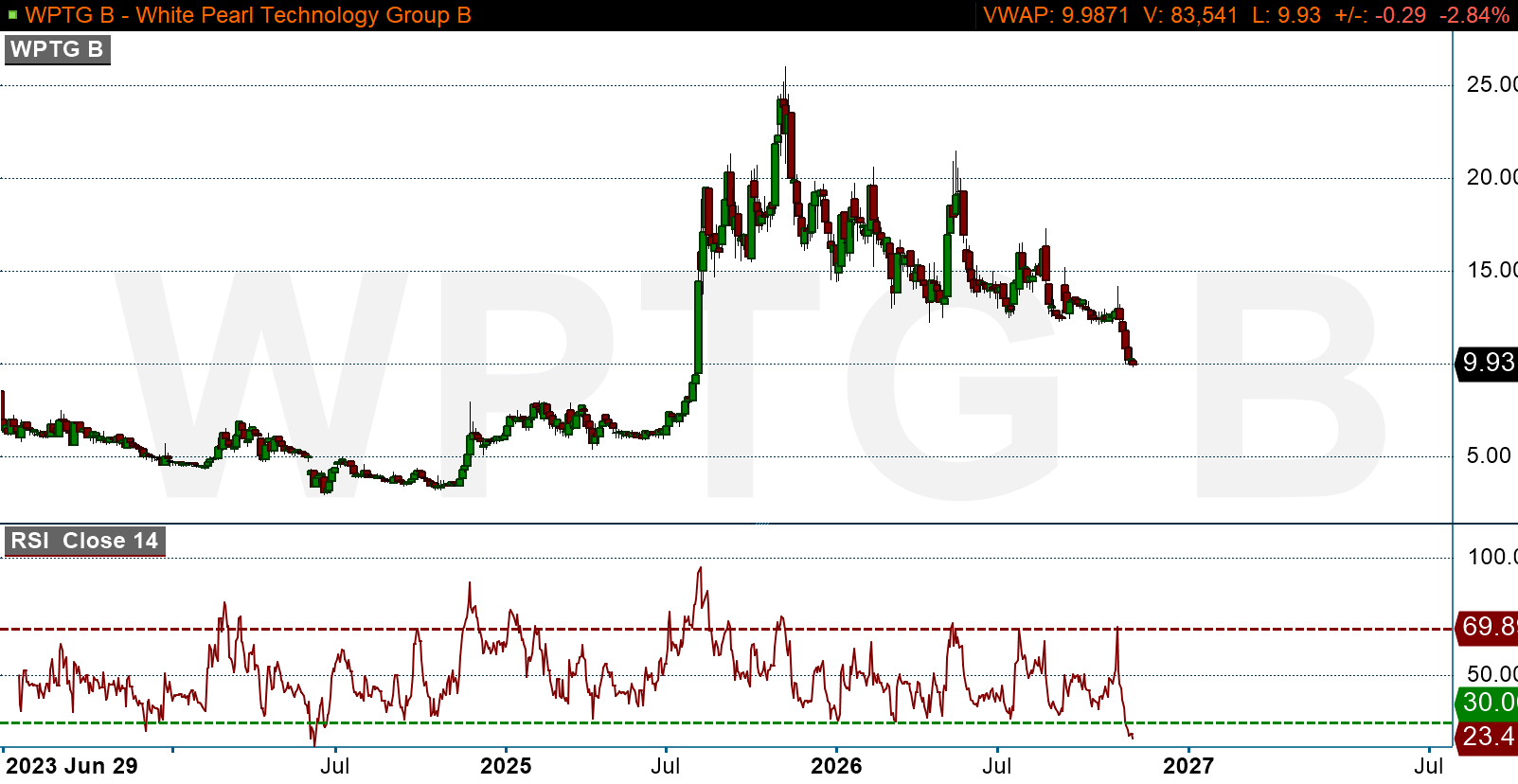 Chart above: White Pearl Technology Group (chart source: Infront/Dagens Börs)


